Monday, September 7, 2020

Free Yet Bound

The following original article can be found at the link below. I have reproduced it in order to highlight and comment on particular points. Anything that is either emboldened, italicized, underline, (in parentheses) or *starred are by me - except for the title and Roman numerated section headings, which were already emboldened in the original article.

https://www.monergism.com/thethreshold/articles/onsite/freewill_chantry.html

_____________________________________

Man's Will- Free Yet Bound
by Walter J. Chantry

    For more than fifteen hundred years the Church has engaged in a heated debate over the freedom of man's will. The major issues came to general attention in the early fifth century when Augustine and Pelagius did battle on the subject. Through medieval times the nature of man's freedom received a great deal of attention. As they studied the Scriptures, Bernard and Anselm made significant contributions to the doctrine of the human will. In the sixteenth century the freedom or bondage of the will was one of the chief issues dividing Reformers and Roman Catholics. To the mind of Martin Luther, it was the key to his dispute with Rome. In the seventeenth century the nature of man's freedom was at the heart of the debate between Arminians and Calvinists. The conflict surfaced again in the eighteenth century during the Great Awakening. Finney's approach to revival in the nineteenth century led the church astray through a misunderstanding of the human will. So too the nature of man's will continues to bring intense disagreement between Reformed and Fundamentalist believers.
     
A proper understanding of the content of the gospel and the use of GOD-honouring methods in evangelism are dependent on one's grasp of this issue.
     
Some theologians, both Arminian and Calvinistic, have been quite lucid in their discussions concerning man's will. Others, for example, Jonathan Edwards, have soared into the lofty clouds of philosophy where many a believer faints in the thin air of difficult logic and complex thought. But none is so refreshingly clear as our holy LORD. His instruction on the subject is laced with vivid illustrations to assist our groping minds:
     
Matthew
12.33-37 says, *'Either make the tree good, and his fruit good; or else make the tree corrupt, and his fruit corrupt: for the tree is known by his fruit. O generation of vipers, how can ye, being evil, speak good things? For out of the abundance of the heart, the mouth speaketh. A good man out of the good treasure of the heart bringeth forth good things: and an evil man out of the evil treasure bringeth forth evil things.  

But I say unto you, that every idle word that men shall speak, they shall give account thereof in the day of judgment. For by thy words thou shalt be justified, and by thy words thou shalt be condemned.'

*The ERV gives a helpful interpretation of the above passage so I offer it here for your edification...

33 “If you want good fruit, you must make the tree good. If your tree is not good, it will have bad fruit. A tree is known by the kind of fruit it produces. 34 You snakes! You are so evil. How can you say anything good? What people say with their mouths comes from what fills their hearts. 35 Those who are good have good things saved in their hearts. That’s why they say good things. But those who are evil have hearts full of evil, and that’s why they say things that are evil. 36 I tell you that everyone will have to answer for all the careless things they have said (the evidence of an evil heart which is the underlying reason they will be judged). This will happen on the day of judgment. 37 Your words will be used (as evidence) to judge you. What you have said will show whether you are right (in your heart) or whether you are guilty (have an evil heart).” ERV

     In this passage are three verbal windows through which the light of Christ's lesson passes. Each presents a familiar scene. (1) A tree that has fruit - v. 33. (2) A man who brings treasures out of a chest - v. 35. (3) A stream that overflows from a fountain. This last is rather more obscure than the first two, but it is suggested by our LORD's choice of words in v. 34. The word 'abundance' suggests superfluity or overflow.
 
     I. Man has a will and that will has a certain freedom. Our LORD clearly teaches that man has a power of choice. It is important to begin here to disarm opponents of all the foolish accusations that have been brought against the Biblical doctrine of man's will. Every man has the ability to choose his own words, to decide what his actions will be. We have a faculty of self-determination in the sense that we select our own thoughts, words, and deeds. Man is free to choose what he prefers, what he desires.

     No one ties fruit on a tree's branches, not even GOD. The tree bears its own fruit. Evil men sin voluntarily; they take evil treasures out of their chests, that is, evil words and deeds. Righteous men are holy by choice; they select good treasures, that is, good words and works. The person who is speaking and acting is completely responsible for his moral behaviour. This power of the will is a vital part of human personality. It always exists in you and me and in all to whom we witness or preach.

     GOD never forces men to act against their wills. By workings of outward providence or of inward grace, the LORD may change men's minds, but He will not coerce a human being into thoughts, words or actions. When GOD in His holy wrath sent the Israelites to drive the Canaanites from their land, He also sent hornets against them. There is a children's song which tells the story of these hornets stinging the Canaanites, causing the pagans to flee the land. The chorus then sings:

GOD never compels us to go, Oh no,
He never compels us to go;
GOD does not compel us to go 'gainst our will,
but He just makes us *willing to go.

*A contemporary expression we hear often can also illustrate this. We have heard it said "you can lead a horse to water, but you can't make it drink" - however you can always salt its oats. The horse may still refuse to drink, but given the nature of its being - how it was created - it must have water to live. And if water is offered, it is likely to drink it, but only by its own free choice.

When Saul was converted, the LORD did not compel him to edify the church instead of persecuting it. He *added a new factor of inward grace in his soul. Consequently, Paul changed his decision. GOD may renew (or excite) the will but He never coerces it.

*I would say God restored that which was lost when we turned away from Him, i.e. Paul was given a new awareness of God's presence or you could say God revealed himself to Paul. This revelation was gracious because it is undeserved. Some may assert it's unfair Christ revealed himself to Paul but not others in the same way. However scripture says God resists the proud and gives grace to the humble. When Christ meet Paul on the road to Damascus Paul humbled himself. He could have chosen to not do so. 
     The Westminster Confession is very careful to assert the liberty of the human will. When it speaks of GOD's eternal decrees, we are told, 'GOD from all eternity did . . . freely and unchangeably ordain whatsoever comes to pass: yet so, as thereby neither is GOD the author of sin, nor is violence offered to - i.e. done against - the will of the creatures, nor is the liberty or contingency of second causes taken away, but rather established.' When discussing Free Will, the Confession begins, 'GOD hath endued the will of man with that natural liberty, that it is neither forced nor by any absolute necessity of nature determined, to good or evil.' Neither by creation nor by subsequent acts of GOD are man's decisions made for him; he is free to choose for himself.

     This sort of freedom of the will is essential to responsibility! Having a will is a necessary ingredient to being morally accountable. This is clearly implied in our LORD's words in verses 36 and 37: 'I say unto you, that every idle word that men shall speak, they shall give account thereof in the day of judgment. For *by thy words thou shalt be justified, and by thy words thou shalt be condemned.' A man can be condemned only because the words are his own (and give evidence of the condemned status under which he already exists). He was free to bring them out of his treasure chest. They were the overflow of the fountain of his own heart. They are the fruits of his own tree of nature. No one imposed the words on his lips. He chose them. Society, companions, parents cannot be blamed. Idle words are the product of the man's own will.
*our words and deeds are evidence of the true condition of our heart i.e. whether our heart is in rebellion to God or in receipt of God's love. If the former, our deeds will be bad and if the latter they will be good. 

      It is vital for every minister to appreciate the importance of man's will. For in evangelism the will must be addressed. In preaching the gospel we are not only to shine the light of truth upon darkened minds. We are also to appeal to men's perverted wills to choose Christ. Faith is as much (I would add primarily and fundamentally) an act of the will as it is of the mind. When by the Spirit a mind understands essential truths, by the same Spirit the will must (choose to believe those truths and) trust Christ. Repentance is a selecting of good and a refusing of evil. Volition is central to faith and repentance.
 
     Indeed, in conversion, a man must make a decision. We shy away from that term because in modern jargon a 'decision' has come to be identified with an outward expression, such as raising the hand or going forward to the front. While such external acts have nothing to do with forgiveness of sins, the heart must make a decision to be saved.


     When Christ stood to cry 'If any man thirst, let him come unto me and drink,' He was soliciting a willing choice of Himself as satisfying drink for the soul. GOD urges all sinners to come just because they may come. And it is our duty to inform the sinner that he has a warrant, a right to choose Christ. Beyond this, we must assure him that he has a positive duty to embrace the Saviour.

     The great guilt of sinners under the gospel is that they will not come (not that they committed certain sins but they refuse God's remedy for those sins i.e. the only remedy for their heart of rebellion to God). Christ complained in John 5.40: 

'Ye will not come to me that ye might have life.' And to Jerusalem He sobbed, 'O Jerusalem, Jerusalem, how often would I have gathered thy children together, even as a hen gathereth her chickens under her wings and ye would not!' There is in the unregenerate hearer of the gospel an obstinate, willful choice not to come (i.e. a rebellious heart). Hence it is that in flaming fire Christ will come to take vengeance on them that obey not the gospel [2 Thess 1.8]. In the free exercise of their uncoerced wills men have rejected the Son of GOD.

     In speaking of responsibility we have implied nothing regarding ability, as will be seen below. But the point is that men have wills which must be addressed as powerfully and directly as their minds and emotions in gospel preaching. Men must be confronted with their responsibility. 'This is the work of GOD, that ye believe into Him whom He hath sent' [John 6.29].
 
     II. Man's Will is not a Sovereign Faculty. Although man does have a will, it is neither *independent of all influences nor supreme over all other parts of his personality. This is the next point to be seen in our LORD's teaching.

*by virtue of being created - i.e. a creature and not the Creator - mankind is dependent. This is obvious and as simple as man must have food, air, and water to stay alive. When faced with the prospect of losing his life due to the absence of any of these, does he look to God or attempt to be his own god. Am I saying man should not seek food, air, and water? No, I am asking whether he recognizes and acknowledges God as the giver and sustainer of these things i.e. does he thank God for them. 
     Pelagians, Roman Catholics, Arminians and Finneyites have all held one common view of the nature of man. They suggest that the will of man is in some way neutral, that it exists in a state of moral suspension. It is their understanding that with equal ease the will can choose good or evil; it can receive or reject Christ. With only degrees of difference and variety of explanation, this is their common opinion. Pelagians have taught that the will is neutral because man's heart is morally neutral. Arminians, on the other hand, acknowledge the human heart to be evil. But they suggest that prevenient grace has hung the will upon a 'sky hook' of neutrality from which it can swing either to receive or to reject the gospel. The common ground, however, is this idea of neutrality. The will, they tell us, is disinterested. Ultimately this controls their entire view of conversion and of sanctification.

     It will be noted that our Master taught that the human will is not free from the other faculties of the heart. Far from the will reigning over a man, the will is determined by the man's own character. It is not raised to a position of dominance over the entire man.

     Man is like a tree. His heart, not his will alone, is the root. There is no possible way by which the will can choose to produce fruit contrary to the character of the root. If the root is bad, the tree is bound by its very nature to produce evil fruit. Man is like a person standing alongside his treasure chest. There is no possibility of bringing pure gold out of a box filled only with rusty steel. The contents of the heart determine what words and deeds may be brought out. Far from being neutral, the will must reach into the heart for its choices. Every thought, word and deed will partake of the nature of the treasure within. Man is like a stream which cannot rise above its source. If the fountain is polluted, the outflow will be evil. If the source be sweet, the stream will not be bitter and cannot choose to be so.

     These three illustrations alike contain the same lesson. What a man is determines what he chooses. Choices of the will always reveal the character of the heart, because the heart determines the choices. Men are not sinners because they choose to sin; they choose to sin because they are sinners. If this were not so, we could never know a tree by its fruits, nor could we judge a man's character by his acts.

     In modern times we observe rockets fired so that they escape from the earth's gravity. To accomplish this there is a great complex of electrical wires all woven into one control centre, called in the U.S. 'Mission Control.'

According to the Bible, the heart is the Mission Control of a man's life. The heart is the motivational complex of a man, the basic disposition, the entire bent of character, the moral inclination. The mind, emotions, desires, and will are all wires which we observe; none is independent but all are welded into a common circuit. If mission control is wired for evil, the will cannot make the rockets of life travel on the path of righteousness. The will cannot escape the direction of thoughts, feelings, longings and habits to produce behaviour of an opposite moral quality. 'Will' may be the button which launches the spacecraft. But the launching button does not determine the direction. Direction is dependent upon the complex wiring system.

     If the will were able to make decisions contrary to reason, and to the likes and desires of the heart, it would be a monster. You would find yourself in a restaurant ordering all the foods you detest. You would find yourself selecting the company you loathe. But the will is not a monster. It cannot choose without consulting your intelligence, reflecting your feelings, and taking account of your desires. You are free to be yourself. The will cannot transform you into someone else.

     This is most profoundly true in the moral and religious realms. When the mind is at war with GOD, denying His truth; when the emotions hate Christ His Son; when the desires wish GOD's law and gospel were exterminated from the earth; the will cannot be in a position to choose Christ. If it were, a man would not be truly free to be himself.  Here is the tragic truth about man's will. While free from outward coercion, it is in a state of bondage (inward vs outward bondage). It is not in a state of neutrality. It is not a lever with which to move a man's personality from sin to righteousness, from unbelief to faith. This brings us to the third element in Christ's words.
 
     III. Man's Will is in Bondage to Sin. The chains which bind a man's will to sin (rebellious unbelief) do not result from the *actions of the Omnipotent GOD. The binding chains are the man's own depraved faculties. The prison is his own nature.

*God does not coerce man to act a certain way but rather the absence of God results in man choosing to act contrary to God and His design. God's absence was the result of man choosing to believe he could do better independent of God vs dependent on Him. He believed he could be his own god instead of trusting in and depending on the only true God. However mankind was not designed to operate as his own god. Therefore he flourishes when he is in union with God, not in rebellion to him. 

     Our LORD's rhetorical question in verse 34 brings this home with force: 'O generation of vipers, how can ye, being evil, speak good things?' Our wise LORD is suggesting that a man must speak as he does because of what he is. To sinners He was saying 'You are unable to choose good words because you possess an evil heart. If the tree is bad, if the treasure chest is filled with evil things alone, if the fountain is bitter, your will cannot produce good words [fruits, treasures, overflow].'

     At this point there are very many scriptures which attest to a man's bondage to sin by his own nature. To mention but a few - Jeremiah 13.23: 'Can the Ethiopian change his skin, or the leopard his spots? Then may ye also do good, that are accustomed to do evil;' John 6.44: 'No man can come to me, except the Father which hath sent me draw him;' Romans 8.7: 'The carnal mind . . . is not subject to the law of GOD, neither indeed can be.'
 
     Pelagian, Arminian and modern Fundamentalist support for the moral and spiritual freedom of the will usually centers on one point. We have admitted that man has a responsible freedom. He is free to be himself. He is held accountable for his words and deeds, especially for his receiving or rejecting Christ. On all of this we agree. They use this toehold to argue that the will is not in bondage to sin but has the power of contrary choice. It can do either good or evil, at least when confronted with the gospel. They insist that the responsibility of the will to choose Christ implies ability of the will to choose Christ.

     There is no scriptural defence of this belief, none that I have ever seen in print. The argument is completely philosophical. It runs as follows: If a man cannot do good, it would be unjust to punish him as evil. Furthermore, if a sinner cannot repent, it would be foolish to command all men everywhere to repent. GOD is not foolish and He has commanded repentance. Therefore men are able to repent.

     We can only reply that those who applaud the powers of the will with such arguments have not read the Bible very carefully. To maintain their philosophical premises they will have to argue with Christ their LORD. For our Prophet tells us in verses 36 and 37 of our text that in the day of judgment men will be held responsible for their evil words. Yet in verse 34 our Teacher tells the very same men that they cannot speak good words because they are bound by their evil character.

     Lazarus in his tomb had no ability to respond when our LORD commanded, 'Come forth.' The man who had been impotent for 38 years had no native ability to obey when Jesus commanded him to take up his bed and walk. Nor have modern sinners ability to believe when we preach. 'This is his commandment, that we believe on the name of his Son Jesus Christ' [I John 3.23].

     When a sinner refuses to come to Christ, he is guilty because he has made a free choice. It reflects his own state of mind, feeling and attitude toward GOD and His Son. He has acted voluntarily without coercion. It is his decision. But the poor sinner, dead in trespasses and sins, could not do otherwise, being evil. It is not necessary for him to have a neutral will, or the ability to do both good and evil, for his action to be held accountable before the Judge of all hearts.

     Anselm is very helpful on this matter. This medieval theologian points out that if ability to sin is necessary to true liberty or responsibility, then GOD is neither free nor praiseworthy. For the scriptures teach us that GOD cannot lie. Similarly, saints in glory will be neither free nor responsible; for in eternity the LORD's people have confirmed righteousness. Anselm goes on to show the Biblical emphasis of freedom. True liberty rests in the ability to do good whereas he that does sin is the slave of sin. If true liberty rests in the ability to do good in GOD's sight, then the highest liberty rests in the inability to do otherwise. This highest freedom belongs to the sons of GOD in glory. How Biblical were Anselm's insights!
 
     No doubt Anselm's thinking has influenced the Westminster Confession's wording in the chapter 'Of Free Will.' For it says that Adam 'had freedom and power to will and to do that which is good and well pleasing to GOD.' Yet this freedom was mutable, subject to change. Man could and did lose his liberty in the sense of being able to do good. This is not the same as a man's liberty to be himself. 'Man, by his fall into a state of sin, hath wholly lost all ability of will to any spiritual good accompanying salvation; so as a natural man, being altogether averse from that good, and dead in sin, is not able, by his own strength, to convert himself, or prepare himself thereto.'

     Bernard was very near the truth when he wrote of our condition in Adam: 'The soul, in some strange and evil way, is held under this kind of voluntary, yet sadly free necessity, both bond and free; bond in respect of necessity, free in respect of will: and what is still more strange, and still more miserable, it is guilty because free, and enslaved because guilty, and therefore enslaved because free.'

     We have seen that man is free to be himself and therefore is enslaved to sin by a wicked heart. And this brings us to the most profound truth regarding the salvation of souls. It is crucial to our preaching. It is vital to saving impressions in our hearers.
 
     IV. Man's Will is not his Hope. Our LORD has taught that the tree must be made good. Man must be renewed in his entire character. He must have a new heart to bring forth good fruit; the will cannot make the tree good; it may only exercise liberty to be what the tree already is. The will cannot reload the treasure chest with a new kind of goods; it may only freely bring forth what is there. The will cannot cleanse the fountainhead; it may overflow only with the waters available in the soul.

     Any gospel preaching that relies upon an act of the human will for the conversion of sinners has missed the mark. Any sinner who supposes that his will has the strength to do any good accompanying salvation is greatly deluded and far from the kingdom. We are cast back upon the regenerating work of the Spirit of the living GOD to make the tree good. Unless GOD does something in the sinner, unless GOD creates a clean heart and renews a right spirit within man, there is no hope of a saving change.

    While we address the wills of men in gospel preaching, they are wills bound in the grave clothes of an evil heart. But as we speak, and the LORD owns His word, sinners are quickened to life by divine power. His people are made willing in the day of His power [Psa 110.3]. All who are adopted as sons of GOD were 'born not of the will of man, but of GOD.' [John 1. 13] We stand to preach with no power to make the tree good. The 'trees' before us cannot make themselves good, so no gimmicks or policies of men can persuade them to make the change. But our glorious GOD, by inward, secret, transforming power, can make the tree good, the treasures good, the fountain good. Thus all glory be to GOD and to the Lamb! Salvation is of the LORD!

“ This article reproduced by permission from THE BANNER OF TRUTH magazine, Issue 140, May 1975.”


· "Free" will or heavily influenced? click here

·        Why Calvinists and Arminians are both wrong click here

·        Our "wanter" is broken, not our "chooser" click here 

·        Why freedom of choice is important click here

·       The question of fairness click here

·       The necessity of mercy click here.

·       Is the election and wrath of God unreasonable? click here

·   Is God free? click here to find out more.


Tuesday, September 1, 2020

Is God free?

Can God act against his honor?

If God is all glorious - as He claims - to act against His honor would be contrary to his character and living a lie. God will not act contrary to his nature. In fact, He can not.

So is God not free? In this sense, He is not. His choices are determined by his character. This is not a limitation of God, it simply means God is who He is and He acts accordingly.

We would never say God is not free because he freely chooses to do whatever he wills and whatever He wills, he does. Nothing outside of God can ¹prevent Him from choosing what He wills or from carrying it out. But he also wills what his character "dictates" i.e. His choices are determined by his nature; who he is, what he is like, etc.

And what is God like? He is love, life, and light, and acts accordingly. These are some of his primary attributes that determine his choices.

What about us? 

How do our choices come about? We were designed for life, not ²death so we naturally choose whatever we ³think best brings us life, good, blessing, etc., not harm or destruction.

We are also free to choose whatever we want. But, what we want is determined by what we ³believe will be in our best interests i.e. what will bring us good, not evil, life not death, light not darkness. Unlike God, we don't know everything that needs to be known, to know with certainty our choices are best for us. Since we choose to be our own god, we cut ourselves off from the Source of infinite knowledge and must base our choice on what we believe is best. But we have no way to truly know what is best in the overall scheme of things because we are not all-knowing but finite. For a further discussion on this point click here

Also, in our current state of rebellious distrust of God, we cannot see God as He is - or ourselves as we truly are - and therefore we do not see what is best and why God is best for us. The Bible says we are spiritually blind and dead in our sin (the essence of sin is unbelief). Outside of Christ, we are rebels and enemies of God. To act as if we are god when he is the only true God is contrary to Him and actually opposed to Him i.e. we are taking the posture of being His enemy. If this seems harsh, it's simply because there is only one God. To claim we are Him when we are not is in opposition to reality i.e. God Himself, whether consciously or not. This disposition cuts us off from seeing and knowing him as he truly is. In a word, we are spiritually blind. 

So is humankind free to choose what they want? Yes, they are. This is not our problem. What we want is. We want the wrong thing. And we want the wrong thing because we died spiritually at our rebellion and can no longer see clearly spiritually. The bible characterized us as being spiritually blind. We want to be our ⁴own god when he alone is the only true God. 

This does not work and can not work because being our own god is contrary to the reality of what is i.e. who God is and how He designed us and the rest of creation to operate. It is actually living a lie.

For a discussion on why free choice is real and necessary click here

For further discussion on free will click here

For a discussion on how our "wanter" is broken, not our "chooser" click here.

For a discussion on how we are free yet bound click here

For a discussion on why Calvinists and Arminians are both wrong, click here, 

For a discussion on how hell is our own choice click here.

For a further discussion of how everyone lives by faith, including atheists, click here.

_____________________________________

¹Or cause God to choose what he does. God is his own cause. Nothing outside of him causes him to do what he does. 

²Due to our rebellion from God as the true source of love and life, we cut ourselves off from him resulting in death. Now we go about seeking to fill the void created by God's absence i.e. The absence of ultimate life - God Himself.

³What we believe, is shaped by our rebellion and therefore is skewed i.e. Since we rejected God by seeking to be our own god, we have set out to obtain life apart from him i.e. we have rejected God as a viable option. However, finding life apart from God is simply not possible because all life comes from and through him.

There is no permanent life outside of God but only temporary life through creation, which is soley sustained by God i.e. The life we find in creation is indirectly life from God.

⁴The inherent problem of being our own god is this requires infinite knowledge and power i.e. We must know what is best (which requires being everywhere present to know all there is to know about all that is, in order to determine what is best) and have the ability (power) to obtain it. In short we must be all knowing (omniscient), everywhere present (omnipresent), and all powerful (omnipotent) i.e. we must be infinite in every way, which we clearly are not. When we "get" this it clearly exposes the foolishness of trying to be our own god or even believing we could be.


Sunday, August 16, 2020

The gospel driven life is all about Christ

* What is a key benefit of suffering?

It increases our appreciation for Christ's love and suffering for us.

* What is a key benefit of increasing awareness of our distrust of God, i.e. of our brokenness?

It increases our appreciation for Christ's love and suffering for us.

* What is a key benefit of our increased faithfulness-obedience to God?

It increases our appreciation for Christ's love and suffering for us. 

Everything about our present experience, awareness, and conduct should remind us of Christ's love and what he did for us. This is the essence of a “gospel-driven” life. 

Our increasingly greater understanding and appreciation of Christ's love and suffering for us causes us to love him in return which is the "engine" that drives us to live for the glory of God. The more fully we understand what Christ did to restore us back to the Father the more glorious he becomes for us and the more we fall in love with Christ and the Father. Our faithfulness is driven by love - the Spirit - and our love is driven by our relationship-union with the Source of love and life - the Father, Son, and Spirit.

For a discussion on how our suffering reveals God's love click here.

For a further discussion on the benefits of suffering, click here

For a further discussion on understanding our brokenness, click here.

For a further discussion on the importance of obedience, click here. 


Tuesday, July 28, 2020

don't eat it or else

Gen 2:17 but of the tree of the knowledge of good and evil you shall not eat, for in the day that you eat of it you shall surely die.
Adam had no clue as to what it meant to die. In this, he had to completely trust whatever dying was. It was not a good thing, and to not eat of this particular tree was the right/good/better choice solely because God said so. He had no proof. He had to follow this directive based only on trust. 

He hadn't experienced or seen death. He didn't know what it was. He had no evil (death) to contrast with the good (life) he had already and had always taken part in. He only knew good, not good, and evil.

Simply stated, if he had fully trusted God, he would not have eaten. Him not eating would have been an act of trust in the Father's warning, that God was telling Adam what was in his best interest. That God only wanted life for him, not death. 

Adam did not believe God but rejected His advance. He decided - and believed - he could do for himself what God couldn't. He decided he could and would be his own god. Man to this day continues on this very same path that leads to death, not life. 

For a further discussion on knowing good and evil, click here

For a further discussion on God using evil for good click here.

For a further discussion on how both evil and good reveal something about God click here.


Monday, July 20, 2020

Obedience, the fruit of abiding.

To be *told we should be loving is true but alone it is not helpful. Being loving is not something we can will ourselves to do, it comes from who we are. 

And who is that?  If we are in Christ, we are beloved children of God.

When we know we are loved, cherished, and valued, we will be loving. Being perfectly and infinitely loved frees us to love others. To use a biblical analogy if we abide - be, dwell, live - in the Vine we will bear much fruit. Without the love of Christ driving our conduct, we can do nothing truly honoring to God (Jn 15:5,9). We are designed for love and to love others, we only lack the power, or I should say we lack the love that empowers us to love others sacrificially.

That power is outside us and comes to us from the Source of love, i.e. God. When it does, it frees us from the need to be loved by others because we are already fully loved
by God in and through Christ, the vine. 

To follow the analogy, God the Father is the caretaker of the vine, the vine is the source of spiritual nutrients-sap to the branches. The branches bear fruit as the nutrients (love) flows through the Vine into the branches. As a result, instead of looking to others to meet our need for love - approval etc - we are freed by God's love - we can now look outward and not inward - and no longer need to tend to our own need for love because God already tends to it. And because he does we can now see the need pf others and be the conduit of God's love to them. God's love for us, when we truly believe and receive it, frees us to love others.

Knowing this is humbling. If or when people are inclined to praise us for our loving character or good deeds we recognize how totally bankrupt we are without God loving us 1st. Without Christ, we can not love as God loves or as we naturally love ourselves. Our actions are not flowing out or giving to others, but are designed instead to "get" or take from others. In fact, we cannot receive God's love until we see how desperately we are in need of it and how impossible it is for us to love others sacrificially - i.e. truly - without receiving God's love first. Only he can satisfy our need for love, which frees us to love others. Truly, without him, without our constant abiding in his love, we can do nothing (Jn 15:5) i.e. we can not love the way God loves.

For a further discussion on being vs doing click here

For a discussion on how our need for love is infinite click here

For a discussion on how conflict is rooted in the absence of love click here

For a discussion on how God has already proved his love click here

For a discussion on how the essence of our work in sanctification is to believe click here.

______________________________________________________________

*We think these are only words of obedience, but they are words of love and promise. Promise of what? Of his steadfast love. That he is the Vine through which this love and life flows to us causing us to be fruitful - obedient. When we believe these words we bear much fruit.


Sunday, July 5, 2020

A dangerous assumption about God's will

The following article by Kevin Thomson is clear, concise, and exceptional. I have reproduced it below to add some links to related topics at the end of the article. The original post is at https://www.kevinathompson.com/dangerous-assumption-gods-will/

_________________________________

A  DANGEROUS  ASSUMPTION  ABOUT  GOD’S  WILL
He made all the right decisions. He dated slowly, chose wisely, did everything I asked of him in pre-marital counseling, and despite all his wise choices, his wife left him just months into the marriage.
She made all the right decisions. Three job offers were on the table. Her knowledge and ability was recognized by everyone. She ¹prayed, sought wise counsel, and made the best decision she knew to make. Within the year the company failed and she was without a job.
There is a common assumption regarding God’s will. It’s the belief that success is the ultimate sign of choosing correctly. It’s the belief that if you make a decision which honors God, God will honor you with success. It’s a dangerous assumption.
I hear it as people are:
debating which job to take. The assumption is that if they chose the right one they will be happy, make money, and experience tremendous success. (See: How Tyler Wilson Made a Good Decision that Cost Him Millions)
choosing a spouse. Choose the right one and the marriage is guaranteed to make it. (See: The Number One Cause of Divorce)
making faith decisions. If they obey God, they assume everything will turn out for the best.
In part, this is true. In the end, God will use everything for our good. Yet the end is a long way off, and between now and then we are not guaranteed health, wealth, and success.
As a matter of fact, it is very possible to make a wise choice and have a bad outcome.
As much as we want to control our lives and guarantee outcomes, they are rarely controllable and never guaranteed.
Of course there is a general principle that good choices lead to good consequences and bad choices lead to bad consequences. Some of life is controllable and some outcomes are guaranteed. Addictions will not end well. Disobeying God rarely benefits in the short-term and will never benefit us in the long-term.
Yet making good choices does not guarantee an outcome we will love. Praying, listening to wise counsel, reading the Bible, and doing everything in our power to make a wise choice does not mean a new job will be easy, that a marriage will be perfect, or that doing what the Bible says will lead to a reconciled friendship or popularity. (See: Karma or Grace)
The best example of this might be a popular verse. For many people, Jeremiah 29.11 is a life verse. The promise of God is that He has a plan for us—a plan to prosper us and not to harm us, a plan to give us a hope and future. It is a tremendous verse.
But do you know the context of Jeremiah 29? It’s in relation to God’s people being in exile. God is reminding His people that even as they suffer, He has not forgotten them. It’s a verse of great hope, but it’s a verse which shows that hope will not come immediately. They would spend 70 years in exile. Entire generations would pass before this verse would be fulfilled. The verse is often the exact opposite of what many people assume about God’s will. (See: How We Respond to Suffering)
pinterest

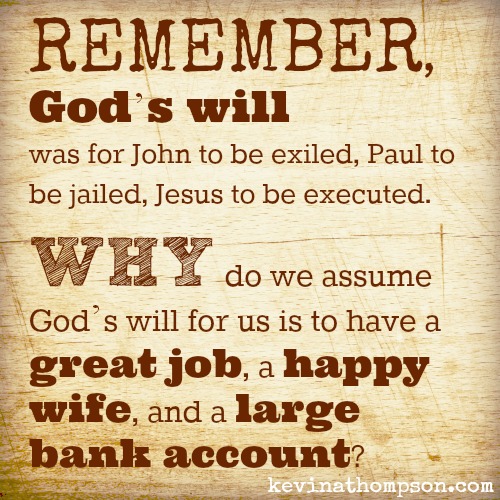
Remember, God’s will was for John to be exiled, Paul to be jailed, Jesus to be executed. Why do we assume God’s will for us is to have a great job, a happy wife, and a large bank account?
Obey. And if suffering or failure follows your obedience, don’t be too quick to assume you have chosen wrongly. You obey and leave the outcomes to God.
Some related topics:
For a discussion on why a circumstantially terrible outcome can still be good, click here
For a discussion on being in God's will click here
For a discussion on how all things work together for good, click here
For a discussion on the dangers and fallacy of the prosperity gospel click here
___________________________________
*I'm not saying this was the case in this example but praying alone does not mean it's a good prayer. What do I mean? Christ said do not pray like the Pharisee's pray. Why? He later says they prayed to be seen of men. We can translate that to mean we aren't seeking God in our prayers but something else and asking God to come alongside us and give is what we think is best i.e. God isn't our end, only a means to something want more than God. Our problem is we don't often know what's best. Only God does. This is why Christ said "not my will but yours be done" after asking the Father to spare him the suffering he was about to face. 

Tuesday, June 30, 2020

What exactly is privilege?

You may have heard the expression the "upside-down gospel."  What exactly does this mean? The gospel is counter-intuitive. We are told to become weak is to be strong, to find your life you must lose it and to be exalted you must be humbled. The meek, not the demanding, inherit the earth. This cuts against common sense and everything within us. 

But the gospel is what we are called to build our lives on by Christ himself, no matter who we are or what ethnic group we belong to. Why do I raise the race question? Because the current racial tension is due to men ignoring the essence of the gospel. To self identify or identify others by a certain race is divisive - and I would suggest often intentionally so. Our true identity can only be found in a relationship of perfect love with our Creator, not some group. Race in today's climate is a destructive label unless in reference to the human race. Then it is uniting. We are all made in the image of God and therefore all equal in the eyes of God. And if we are in Christ and under His rule-kingdom, we are brothers and sisters in Christ. This is our identity, not the pigment of our skin regardless of what others think, say, or do to us. 

In God's economy, the gospel takes privilege - used in the present political sense - and puts it on its head. What is that message? In God's gospel ruled kingdom, the 1st shall be last and the last shall be 1st. This says that those who are last - from the
world's perspective - are more privileged than those who are first with all their earthly advantages and benefits. This is not the message we are given by the world, more so now than ever. 

We must be careful not to forget God's ways are not ours, and ours are not his. Man seeks to understand his world independent of infinite wisdom, i.e. God's wisdom, expressed above. Why? Because he seeks to be his own god and believes his own independent understanding of himself and the world around him is right and sufficient, i.e. it alone can lead him to the truth. But only God is infinite in knowledge and ¹in every other way; man is not. Finite man can never gain access to the infinite on his own. He needs help from someone far greater than himself i.e. someone infinite in knowledge and wisdom. The finite - you and I - can not reach up and bring the Infinite down to us. The Infinite must come down and reveal Himself. And He did in Christ! Yet man rejects God's Son and the wisdom and revelation he offers.

To operate contrary to our design - i.e. to ignore our limits - is foolish. This is like trying to care for a delicate plant or rare animal or operate a complex machine to the maximum of its potential and ignore the manual that tells us how to do so. Man can observe himself and the world around him and definitely discover certain things. But can he discover all that needs to be known unaided? Is there a difference between facts and truth? 

There is. Let me illustrate.

We can all see the sun - unless we are literally blind, but even then we can feel its warmth. No one would dispute there is something bright or warm in the sky. Over time, with enough study, we can discover the specifics of how the sun operates; all are important facts, they are just not all the "facts." 

As hard as science tries, science has never been able to answer the why question. This is different from the "how" questions. Why is the sun there? Why are we here to observe it and experience the benefits that come from it? We may try to find the answer to the why questions through science but discovering the facts of what is, is the role of science, why something exists is not. To this day science has not concluded with certainty why anything is, only how it works. The why must be found elsewhere. We must go to the Designers manual and see what He says about the why of His creation. 

There is man's way of seeing and doing things. Depending on one's worldview, those ways could be the polar opposite of each other. Why? Because man is limited in his understanding if left only to his own reasoning and finiteness i.e. we are not all knowing, all powerful, everywhere present of all loving. Hence all the tension in the world today. Everyone thinks their knowledge is absolute, independent of the source of absolute knowledge. There is usually ²some truth in all views, mixed in with some fallacy, some being more or less true than others. Who decides what is true and who is the arbitrator when these differences create great tension and conflict? Man's sole reliance on his own reasoning and resources in determining truth instead of confiding in the Source of all wisdom and truth will not settle a matter, only inflame it.

When there are opposing views, the truth often lies somewhere in the midst of the tension of those views. Both sides are seeing truth the other is not. Then there is God's way or a 3rd way if you will. The way of infinite knowledge. The way none of us as finite beings, can see unless God reveals it. And who does he reveal himself to? Those who know they need to see it-Him i.e. those humble enough to recognize that along i.e. without God who is infinite, man can not see all he needs to see to know with certainty his understanding of the world is correct (remember the why questions). 

If we are to resolve the tensions of differing views, we must recognize our limitations and acknowledge true understanding and correct view of the world must come outside us and from the Source of infinite knowledge, love, life, and all things. To see this, we must humble ourselves and recognize we need to see more than we need to be seen or heard. This same source tells us the 1st shall be last and the last shall be 1st and to find our life we must first lose it.
 
So to bring this back around to privilege, those who complain the most about someone being privileged over them or another is to miss the whole gospel message. If one is a believer they will rejoice in their low standing not be envious of what they think is someone else's high standing. 

For a further discussion on strength in weakness, click here.

For a further discussion on identity politics, click here

For a further discussion on the necessity of forgiveness, click here

For a further discussion on values, culture and racism click here

For a discussion on my personal experience of discrimination, click here. 
______________________________________________________________________

*All the "omni's" Omniscience, Omnipotence, Omnipresence and Omni benevolence. Or to say it more practically, all-wise and all-knowing, all-powerful, everywhere present and all good and loving.

**We live in a world of design where we can observe how things operate a particular way. And that is because there is design and a designer who created them to do so. Though we can observe this design and discover to some extent how things operate - some truth about their operation - we can never grasp the full purpose of creations design without acknowledging the Creator who designed them. 

And what is that purpose? All things are from, through, and to God. To him be the glory i.e. He must be recognized as the Creator and sustainer of all things if we are to see them as they truly are.