Tuesday, September 1, 2020

Is God free?

Can God act against his honor?

If God is all glorious - as He claims - to act against His honor would be contrary to his character and living a lie. God will not act contrary to his nature. In fact, He can not.

So is God not free? In this sense, He is not. His choices are determined by his character. This is not a limitation of God, it simply means God is who He is and He acts accordingly.

We would never say God is not free because he freely chooses to do whatever he wills and whatever He wills, he does. Nothing outside of God can ¹prevent Him from choosing what He wills or from carrying it out. But he also wills what his character "dictates" i.e. His choices are determined by his nature; who he is, what he is like, etc.

And what is God like? He is love, life, and light, and acts accordingly. These are some of his primary attributes that determine his choices.

What about us? 

How do our choices come about? We were designed for life, not ²death so we naturally choose whatever we ³think best brings us life, good, blessing, etc., not harm or destruction.

We are also free to choose whatever we want. But, what we want is determined by what we ³believe will be in our best interests i.e. what will bring us good, not evil, life not death, light not darkness. Unlike God, we don't know everything that needs to be known, to know with certainty our choices are best for us. Since we choose to be our own god, we cut ourselves off from the Source of infinite knowledge and must base our choice on what we believe is best. But we have no way to truly know what is best in the overall scheme of things because we are not all-knowing but finite. For a further discussion on this point click here

Also, in our current state of rebellious distrust of God, we cannot see God as He is - or ourselves as we truly are - and therefore we do not see what is best and why God is best for us. The Bible says we are spiritually blind and dead in our sin (the essence of sin is unbelief). Outside of Christ, we are rebels and enemies of God. To act as if we are god when he is the only true God is contrary to Him and actually opposed to Him i.e. we are taking the posture of being His enemy. If this seems harsh, it's simply because there is only one God. To claim we are Him when we are not is in opposition to reality i.e. God Himself, whether consciously or not. This disposition cuts us off from seeing and knowing him as he truly is. In a word, we are spiritually blind. 

So is humankind free to choose what they want? Yes, they are. This is not our problem. What we want is. We want the wrong thing. And we want the wrong thing because we died spiritually at our rebellion and can no longer see clearly spiritually. The bible characterized us as being spiritually blind. We want to be our ⁴own god when he alone is the only true God. 

This does not work and can not work because being our own god is contrary to the reality of what is i.e. who God is and how He designed us and the rest of creation to operate. It is actually living a lie.

For a discussion on why free choice is real and necessary click here

For further discussion on free will click here

For a discussion on how our "wanter" is broken, not our "chooser" click here.

For a discussion on how we are free yet bound click here

For a discussion on why Calvinists and Arminians are both wrong, click here, 

For a discussion on how hell is our own choice click here.

For a further discussion of how everyone lives by faith, including atheists, click here.

_____________________________________

¹Or cause God to choose what he does. God is his own cause. Nothing outside of him causes him to do what he does. 

²Due to our rebellion from God as the true source of love and life, we cut ourselves off from him resulting in death. Now we go about seeking to fill the void created by God's absence i.e. The absence of ultimate life - God Himself.

³What we believe, is shaped by our rebellion and therefore is skewed i.e. Since we rejected God by seeking to be our own god, we have set out to obtain life apart from him i.e. we have rejected God as a viable option. However, finding life apart from God is simply not possible because all life comes from and through him.

There is no permanent life outside of God but only temporary life through creation, which is soley sustained by God i.e. The life we find in creation is indirectly life from God.

⁴The inherent problem of being our own god is this requires infinite knowledge and power i.e. We must know what is best (which requires being everywhere present to know all there is to know about all that is, in order to determine what is best) and have the ability (power) to obtain it. In short we must be all knowing (omniscient), everywhere present (omnipresent), and all powerful (omnipotent) i.e. we must be infinite in every way, which we clearly are not. When we "get" this it clearly exposes the foolishness of trying to be our own god or even believing we could be.


Sunday, August 16, 2020

The gospel driven life is all about Christ

* What is a key benefit of suffering?

It increases our appreciation for Christ's love and suffering for us.

* What is a key benefit of increasing awareness of our distrust of God, i.e. of our brokenness?

It increases our appreciation for Christ's love and suffering for us.

* What is a key benefit of our increased faithfulness-obedience to God?

It increases our appreciation for Christ's love and suffering for us. 

Everything about our present experience, awareness, and conduct should remind us of Christ's love and what he did for us. This is the essence of a “gospel-driven” life. 

Our increasingly greater understanding and appreciation of Christ's love and suffering for us causes us to love him in return which is the "engine" that drives us to live for the glory of God. The more fully we understand what Christ did to restore us back to the Father the more glorious he becomes for us and the more we fall in love with Christ and the Father. Our faithfulness is driven by love - the Spirit - and our love is driven by our relationship-union with the Source of love and life - the Father, Son, and Spirit.

For a discussion on how our suffering reveals God's love click here.

For a further discussion on the benefits of suffering, click here

For a further discussion on understanding our brokenness, click here.

For a further discussion on the importance of obedience, click here. 


Tuesday, July 28, 2020

don't eat it or else

Gen 2:17 but of the tree of the knowledge of good and evil you shall not eat, for in the day that you eat of it you shall surely die.
Adam had no clue as to what it meant to die. In this, he had to completely trust whatever dying was. It was not a good thing, and to not eat of this particular tree was the right/good/better choice solely because God said so. He had no proof. He had to follow this directive based only on trust. 

He hadn't experienced or seen death. He didn't know what it was. He had no evil (death) to contrast with the good (life) he had already and had always taken part in. He only knew good, not good, and evil.

Simply stated, if he had fully trusted God, he would not have eaten. Him not eating would have been an act of trust in the Father's warning, that God was telling Adam what was in his best interest. That God only wanted life for him, not death. 

Adam did not believe God but rejected His advance. He decided - and believed - he could do for himself what God couldn't. He decided he could and would be his own god. Man to this day continues on this very same path that leads to death, not life. 

For a further discussion on knowing good and evil, click here

For a further discussion on God using evil for good click here.

For a further discussion on how both evil and good reveal something about God click here.


Monday, July 20, 2020

Obedience, the fruit of abiding.

To be ¹told we should be loving is true but alone it is not helpful. Being loving is not something we can by mere willpower, it comes from who we are. 

And who is that?  If we are in Christ, we are beloved children of God.

When we know (believe) we are loved, cherished, and valued, we will be loving. Being perfectly and infinitely loved frees us to love others. To use a biblical analogy if we abide - be, dwell, live - in the Vine we will bear much fruit. Without the love of Christ driving our conduct, we can do nothing truly honoring to God (Jn 15:5,9). We are designed for love and to love others, we only lack the power, or I should say we lack the love that empowers us to love others sacrificially.

That power is outside us and comes to us from the Source of love, i.e. God. When it does, it frees us from the need to be loved by others because we are already fully loved
by God in and through Christ, the vine. 

To follow the analogy, God the Father is the caretaker of the vine, the vine is the source of spiritual nutrients-sap to the branches. The branches bear fruit as the nutrients (love) flows through the Vine into the branches. As a result, instead of looking to others to meet our need for love - approval etc - we are freed by God's love - we can now look outward and not inward - and no longer need to tend to our own need for love because God already tends to it. And because he does we can now see the need of others and be the conduit of God's love to them. God's love for us, when we truly believe and receive it, frees us to love others i.e. fruit.

Knowing this is humbling. If or when people are inclined to praise us for our loving character or good deeds we recognize how totally bankrupt we are without God loving us 1st. Without Christ, we can not love as God loves or as we naturally love ourselves. Our actions are not flowing out or giving to others, but are designed instead to "get" or take from others. In fact, we cannot receive God's love until we see how desperately we are in need of it and how impossible it is for us to love others sacrificially - i.e. truly - without receiving God's love first. Only he can satisfy our need for love, which frees us to love others. Truly, without him, without our constant abiding in his love, we can do nothing (Jn 15:5) i.e. we can not love the way God loves.

For a further discussion on being vs doing click here

For a discussion on how our need for love is infinite click here

For a discussion on how conflict is rooted in the absence of love click here

For a discussion on how God has already proved his love click here

For a discussion on how the essence of our work in sanctification is to believe click here.

________________________________________Footnotes:

¹We think these are only words of obedience, but they are words of love and promise. Promise of what? Of his steadfast love. That he is the Vine through which this love and life flows to us causing us to be fruitful - obedient. When we believe these words we bear much fruit.


Sunday, July 5, 2020

A dangerous assumption about God's will

The following article by Kevin Thomson is clear, concise, and exceptional. I have reproduced it below to add some links to related topics at the end of the article. The original post is at https://www.kevinathompson.com/dangerous-assumption-gods-will/

_________________________________

A  DANGEROUS  ASSUMPTION  ABOUT  GOD’S  WILL
He made all the right decisions. He dated slowly, chose wisely, did everything I asked of him in pre-marital counseling, and despite all his wise choices, his wife left him just months into the marriage.
She made all the right decisions. Three job offers were on the table. Her knowledge and ability was recognized by everyone. She ¹prayed, sought wise counsel, and made the best decision she knew to make. Within the year the company failed and she was without a job.
There is a common assumption regarding God’s will. It’s the belief that success is the ultimate sign of choosing correctly. It’s the belief that if you make a decision which honors God, God will honor you with success. It’s a dangerous assumption.
I hear it as people are:
debating which job to take. The assumption is that if they chose the right one they will be happy, make money, and experience tremendous success. (See: How Tyler Wilson Made a Good Decision that Cost Him Millions)
choosing a spouse. Choose the right one and the marriage is guaranteed to make it. (See: The Number One Cause of Divorce)
making faith decisions. If they obey God, they assume everything will turn out for the best.
In part, this is true. In the end, God will use everything for our good. Yet the end is a long way off, and between now and then we are not guaranteed health, wealth, and success.
As a matter of fact, it is very possible to make a wise choice and have a bad outcome.
As much as we want to control our lives and guarantee outcomes, they are rarely controllable and never guaranteed.
Of course there is a general principle that good choices lead to good consequences and bad choices lead to bad consequences. Some of life is controllable and some outcomes are guaranteed. Addictions will not end well. Disobeying God rarely benefits in the short-term and will never benefit us in the long-term.
Yet making good choices does not guarantee an outcome we will love. Praying, listening to wise counsel, reading the Bible, and doing everything in our power to make a wise choice does not mean a new job will be easy, that a marriage will be perfect, or that doing what the Bible says will lead to a reconciled friendship or popularity. (See: Karma or Grace)
The best example of this might be a popular verse. For many people, Jeremiah 29.11 is a life verse. The promise of God is that He has a plan for us—a plan to prosper us and not to harm us, a plan to give us a hope and future. It is a tremendous verse.
But do you know the context of Jeremiah 29? It’s in relation to God’s people being in exile. God is reminding His people that even as they suffer, He has not forgotten them. It’s a verse of great hope, but it’s a verse which shows that hope will not come immediately. They would spend 70 years in exile. Entire generations would pass before this verse would be fulfilled. The verse is often the exact opposite of what many people assume about God’s will. (See: How We Respond to Suffering)
pinterest

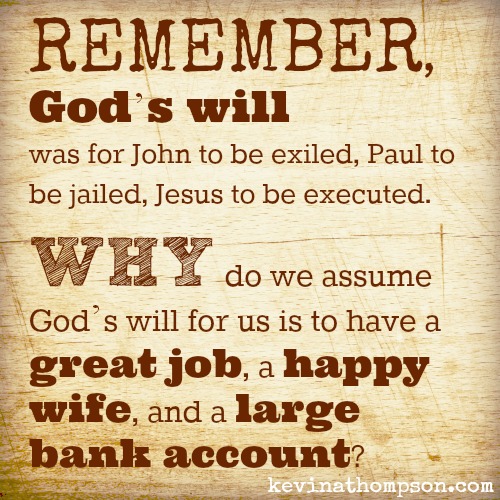
Remember, God’s will was for John to be exiled, Paul to be jailed, Jesus to be executed. Why do we assume God’s will for us is to have a great job, a happy wife, and a large bank account?
Obey. And if suffering or failure follows your obedience, don’t be too quick to assume you have chosen wrongly. You obey and leave the outcomes to God.
Some related topics:
For a discussion on why a circumstantially terrible outcome can still be good, click here
For a discussion on being in God's will click here
For a discussion on how all things work together for good, click here
For a discussion on the dangers and fallacy of the prosperity gospel click here
___________________________________
*I'm not saying this was the case in this example but praying alone does not mean it's a good prayer. What do I mean? Christ said do not pray like the Pharisee's pray. Why? He later says they prayed to be seen of men. We can translate that to mean we aren't seeking God in our prayers but something else and asking God to come alongside us and give is what we think is best i.e. God isn't our end, only a means to something want more than God. Our problem is we don't often know what's best. Only God does. This is why Christ said "not my will but yours be done" after asking the Father to spare him the suffering he was about to face. 

Tuesday, June 30, 2020

What exactly is privilege?

You may have heard the expression the "upside-down gospel."  What exactly does this mean? The gospel is counter-intuitive. We are told to become weak is to be strong, to find your life you must lose it and to be exalted you must be humbled. The meek, not the demanding, inherit the earth. This cuts against common sense and everything within us. 

But the gospel is what we are called to build our lives on by Christ himself, no matter who we are or what ethnic group we belong to. Why do I raise the race question? Because the current racial tension is due to men ignoring the essence of the gospel. To self identify or identify others by a certain race is divisive - and I would suggest often intentionally so. Our true identity can only be found in a relationship of perfect love with our Creator, not some group. Race in today's climate is a destructive label unless in reference to the human race. Then it is uniting. We are all made in the image of God and therefore all equal in the eyes of God. And if we are in Christ and under His rule-kingdom, we are brothers and sisters in Christ. This is our identity, not the pigment of our skin regardless of what others think, say, or do to us. 

In God's economy, the gospel takes privilege - used in the present political sense - and puts it on its head. What is that message? In God's gospel ruled kingdom, the 1st shall be last and the last shall be 1st. This says that those who are last - from the
world's perspective - are more privileged than those who are first with all their earthly advantages and benefits. This is not the message we are given by the world, more so now than ever. 

We must be careful not to forget God's ways are not ours, and ours are not his. Man seeks to understand his world independent of infinite wisdom, i.e. God's wisdom, expressed above. Why? Because he seeks to be his own god and believes his own independent understanding of himself and the world around him is right and sufficient, i.e. it alone can lead him to the truth. But only God is infinite in knowledge and ¹in every other way; man is not. Finite man can never gain access to the infinite on his own. He needs help from someone far greater than himself i.e. someone infinite in knowledge and wisdom. The finite - you and I - can not reach up and bring the Infinite down to us. The Infinite must come down and reveal Himself. And He did in Christ! Yet man rejects God's Son and the wisdom and revelation he offers.

To operate contrary to our design - i.e. to ignore our limits - is foolish. This is like trying to care for a delicate plant or rare animal or operate a complex machine to the maximum of its potential and ignore the manual that tells us how to do so. Man can observe himself and the world around him and definitely discover certain things. But can he discover all that needs to be known unaided? Is there a difference between facts and truth? 

There is. Let me illustrate.

We can all see the sun - unless we are literally blind, but even then we can feel its warmth. No one would dispute there is something bright or warm in the sky. Over time, with enough study, we can discover the specifics of how the sun operates; all are important facts, they are just not all the "facts." 

As hard as science tries, science has never been able to answer the why question. This is different from the "how" questions. Why is the sun there? Why are we here to observe it and experience the benefits that come from it? We may try to find the answer to the why questions through science but discovering the facts of what is, is the role of science, why something exists is not. To this day science has not concluded with certainty why anything is, only how it works. The why must be found elsewhere. We must go to the Designers manual and see what He says about the why of His creation. 

There is man's way of seeing and doing things. Depending on one's worldview, those ways could be the polar opposite of each other. Why? Because man is limited in his understanding if left only to his own reasoning and finiteness i.e. we are not all knowing, all powerful, everywhere present of all loving. Hence all the tension in the world today. Everyone thinks their knowledge is absolute, independent of the source of absolute knowledge. There is usually ²some truth in all views, mixed in with some fallacy, some being more or less true than others. Who decides what is true and who is the arbitrator when these differences create great tension and conflict? Man's sole reliance on his own reasoning and resources in determining truth instead of confiding in the Source of all wisdom and truth will not settle a matter, only inflame it.

When there are opposing views, the truth often lies somewhere in the midst of the tension of those views. Both sides are seeing truth the other is not. Then there is God's way or a 3rd way if you will. The way of infinite knowledge. The way none of us as finite beings, can see unless God reveals it. And who does he reveal himself to? Those who know they need to see it-Him i.e. those humble enough to recognize that along i.e. without God who is infinite, man can not see all he needs to see to know with certainty his understanding of the world is correct (remember the why questions). 

If we are to resolve the tensions of differing views, we must recognize our limitations and acknowledge true understanding and correct view of the world must come outside us and from the Source of infinite knowledge, love, life, and all things. To see this, we must humble ourselves and recognize we need to see more than we need to be seen or heard. This same source tells us the 1st shall be last and the last shall be 1st and to find our life we must first lose it.
 
So to bring this back around to privilege, those who complain the most about someone being privileged over them or another is to miss the whole gospel message. If one is a believer they will rejoice in their low standing not be envious of what they think is someone else's high standing. 

For a further discussion on strength in weakness, click here.

For a further discussion on identity politics, click here

For a further discussion on the necessity of forgiveness, click here

For a further discussion on values, culture and racism click here

For a discussion on my personal experience of discrimination, click here. 
______________________________________________________________________

*All the "omni's" Omniscience, Omnipotence, Omnipresence and Omni benevolence. Or to say it more practically, all-wise and all-knowing, all-powerful, everywhere present and all good and loving.

**We live in a world of design where we can observe how things operate a particular way. And that is because there is design and a designer who created them to do so. Though we can observe this design and discover to some extent how things operate - some truth about their operation - we can never grasp the full purpose of creations design without acknowledging the Creator who designed them. 

And what is that purpose? All things are from, through, and to God. To him be the glory i.e. He must be recognized as the Creator and sustainer of all things if we are to see them as they truly are.


Friday, June 26, 2020

Render unto Caesar

The following article was originally part of a larger paper on "Obeying the Authorities." Though it is related, we felt it better to break this out as a separate article. If you wish to read the full article click here

What does the bible have to say regarding taxes? In this paper, we will look at two key passages; 
 
  1. Peter "volunteering" Christ to pay the temple tax and 
  2. A quote often heard from a minister during a Sunday sermon..."Render unto Caesar what is Caesar's"...

 Matt. 17:24 and following says,

24 "After Jesus and his disciples arrived in Capernaum, the collectors of the two-drachma tax came to Peter and asked, "Doesn't your teacher pay the temple tax?" 25 "Yes, he does," he replied. When Peter came into the house Jesus was the first to speak. (The idea of “first to speak” in the original suggests Christ spoke before Peter could raise the matter. Other translations and particularly "The Message" give a good sense of the original and render it,” But as soon as they were in the house, Jesus confronted him...") "What do you think, Simon?" he asked. "From whom do the kings of the earth collect duty and taxes--from their own sons or from others?" 26 "From others," Peter answered. "Then the sons are exempt," Jesus said to him. 27 "But so that we may not offend them, go to the lake and throw out your line. Take the first fish you catch; open its mouth and you will find a four-drachma coin. Take it and give it to them for my tax and yours." (NIV)


  • The temple tax

There are several things to note in the above passage.

1. Christ's quick querying of Peter was a mild rebuke to Peter for speaking before thinking. (A common characteristic of Peter).

2. Christ used this as an opportunity to instruct Peter.

3. Kings do not collect taxes from their own but others and therefore the sons are exempt. Most Christians simply read right over this focusing on a text and ignoring the context. What Christ is saying is both Christ and Peter, who were "sons" of Israel, are not obligated to pay but are exempt from this tax. But if they were exempt this raises the question, why did Christ instruct Peter to still pay it. We will address that shortly. (It just so happens the son's being exempt is also the case in our system when you study what our tax law REALLY says. You may not be aware of this if you have not taken the time to study what the tax law actually says. It is the foreigner, the non-resident alien, the "other" who are required to file and not the sons (sons being the offspring of the country if you will, i.e. its citizens. It makes one wonder how aware the founders were of this passage when writing the Constitution. You could make the argument that they patterned our tax system after these instructions from Jesus to Peter)

4. Christ did not use his or Peters own money or even money from the disciples "treasury" to pay this tax but Peter got it out of the mouth of a fish. (As a humorous aside could we say that it takes nothing short of a miracle to pay taxes? Just a thought.) Why didn’t Christ simply instruct Peter to pay with their own money or the disciples "treasury" fund? In addition, why didn't Christ have Peter pay for the rest of the disciples and not just for Himself and Peter? This is a clear indication it wasn't required of any of them but since Peter volunteered that Christ paid it, Christ instructed him to put money were his mouth had gone, when he didn't need to.

It is also worth noting Christ instructed Peter to "fix" the problem he created through that which he was most familiar with, fishing. 

How Christ handled this whole event, as well as his querying Peter and then accepting his reply, all indicate that paying the tax in this instance was not a requirement. Christ's reason for instructing Peter to pay the tax appears to be for other reasons listed above.

First, Christ used Peter's presumption and error in judgment as an opportunity to teach Peter an important lesson. As he often did, Peter spoke without thinking, creating a problem. Since Peter created this problem Peter needed to resolve it as well, therefore Christ's unusual instructions for Peter to find a fish and get the money out of its mouth and pay the tax he voluntarily agree (without checking with Christ first) that Christ paid.

Secondly, since Peter had already committed the Lord to pay this tax by saying, "yes he pays it…" obligating both himself and Peter, Christ had Peter pay it to avoid offending someone for the sack of the gospel. (Have you ever had someone volunteer you for something without getting your permission?)

I think it's fair to say if Peter had said, "you will have to ask my Lord", rather than speaking for Christ, Christ would have responded to the inquirers the same way he did Peter by asking them, "From who do the kings of the earth collect...taxes...?" If their response was correct, as was Peter's, their own reply would have acknowledged the tax wasn't required (the sons are exempt) and therefore neither Christ nor Peter would have needed to pay the tax. But for the reasons mentioned, Christ did instruct Peter to pay it, but not because it was required to be paid.

On a separate but related matter, it is worth noting in Luke 19:2-10 that Zacchaeus the tax collector was hated by all and referred to as a sinner. Christ's response was that he had come to save those who were lost, i.e. sinners. This suggests that Zacchaeus was a better than average example. Instead of refuting the crowds' view of Zacchaeus as a sinner, he confirmed it by his reply.

There is not anything necessarily or inherently wrong with taxes or those who collect them, but it is interesting that even in Christ's day the tax system seemed to be a receptacle for the despised and unethical. Do we see any indication this may also be the case today? Zacchaeus was said to be a wealthy man yet his sole source of earnings - supposedly - was the collecting of taxes. He later acknowledged, by his willingness to pay back to those he had collected from, that he had illegally stolen from others by extracting from them more than they owed and using tax collection as a guise. Is there a pattern here we can learn from?

  • Render unto Caesar what is Caesar's… 

Those who advocate that any and all taxes should be paid without question, appear to consistently rely upon the superficial translation of the following passage rather than the context in which this story is set. The key to properly interpreting this statement "render unto Caesar what is Caesar's" is to understand the context which clearly shows that Jesus was responding to a trap being set for him. How he avoided this trap is actually the focus of this passage, not taxes.

Mark 12: 13-16

13Later they sent some of the Pharisees and Herodians to Jesus to catch him in  his words. 14They came to him and said, "Teacher, we know you are a man of integrity. You aren't swayed by men, because you pay no attention to who they are; but you teach the way of God in accordance with the truth (when your antagonists seek to flatter you, beware). Is it right to pay taxes to Caesar or not? 15Should we pay or shouldn't we?" 16But Jesus knew their hypocrisy. (i.e. their question wasn't sincere and the real reason thy were raising it) "Why are you trying to trap me?" he asked. "Bring me a denarius and let me look at it." They brought the coin, and he asked them, "Whose portrait is this? And whose inscription?" "Caesar's," they replied. 17Then Jesus said to them, "Give to Caesar what is Caesar's and to God what is God's." And they were amazed at him.

To be a trap, the intent was that any answer would result in the desired outcome by the trappers. If Christ’s answer was to not pay Caesar the tax (As probably anticipated by the questioners. It is very possible that Jesus was suspected of leading a group of tax rebels who would have disapproved of their leader paying taxes to Rome), Jesus would have convicted himself of a capital crime under Roman law and the questioners would now have an excuse to bring him before Pilot for sentencing. To protest the tax in that day was punishable by crucifixion. The fact that Caiaphas raised this issue later before Pilot to persuade him to crucify Christ supports this. (Lk 23:2 "We have found this man subverting our nation. He opposes payment of taxes to Caesar and claims to be Christ, a king.”)

If, on the other hand, Christ had said it was right to pay Caesar, they would likely have tried to accuse him of being unfaithful to God and therefore not truly the Son of God as he claimed but an impostor, worthy of death.

The Pharisees thought they had set a clever, inescapable trap for Christ. No matter how he answered, they "had" him, or so they thought.

However, the response by Jesus amazed them. Christ saw through their guise i.e. 16… Jesus knew their hypocrisy… and did not give them either response they were hoping for but completely eluded their question and therefore their trap. Christ, instead turned the table and simply put the problem back on them. "Whose portrait is this...?" Christ asked. In essence, he was saying to them, you figure out what belongs to whom and if a tax is due, pay it to the appropriate party.

His answer was not at all an admission of a requirement much less a command to pay taxes to the government of his day - as some often suggest when quoting this particular phrase. To just take the isolated statement, "Give to Caesar what is Caesar's and to God what is God's" without looking at the context is to miss entirely why he made that statement, to begin with. He wasn’t giving a command, He was giving them an answer to their question in a way that avoided the trap they were trying to set.

Because we all tend to approach a passage with preset ideas, we have to always be on guard not to read into the passages what we have predetermined (or wrongfully told) but instead prayerfully seek to see what any given passage is actually saying. Our goal should be extracting from passage within the context as well as the text the meaning, not read a predetermined interpretation into it. As my Hermeneutics professor was fond of telling us, "a text without a context is a pretext."

Tied to this is that we are all prone to interpret the bible according to our fears and emotions. By that I mean if we are afraid of the responsibility a passage places on us (such as taking responsibility for our choices) we will interpret a passage in such a way as to avoid facing those responsibilities or subsequent fears. Instead of changing our thinking, we “change scripture” to fit what is comfortable. Interpretation of certain passages often has far more to do with our emotions than our correct understanding of a passage, i.e. our fears and emotions often color our view/understanding of things, including God's very words.

In addition, there is still the matter of WHO is Caesar and WHAT belongs to "him?" As Christians, we are not opposed to Government (when it operates according to God's word) or the necessity of raising revenue under the specific conditions clearly spelled out in the Constitution. Local authorities do maintain "law and order" by preventing evildoers from wreaking havoc on their fellow citizens (though things have often gone upside down of late when addressing the police). However, we are opposed to those in Government violating the law and raising revenues outside of what the law allows. When they do, this is theft, not unlike what Zacchaeus committed. When this occurs we are not obligated to participate in such thievery but in fact, as stewards, we are entrusted to manage the resources God gives us and to resist attempts at interfering with that responsibility. As Jefferson once said, resistance to tyrants is obedience to God. Though Jefferson was just a man, and possibly not even a Christian, I trust you agree his wisdom was sound and scripturally based.