Showing posts sorted by date for query prosperity gospel. Sort by relevance Show all posts

Saturday, June 22, 2024

Is making a lot of money legit?

Is it legitimate to pursue making a lot of money as an end in itself? No.

However, note the above says the love of money is the problem, not money itself.

If we diligently pursue doing things with excellence for the glory of God, it is not only totally legitimate to be as productive and fruitful as possible, but what we are called to do. 

From the beginning in Genesis and throughout the New Testament, God's mandate to humanity was to be fruitful and multiply i.e. bear much fruit. This honors God.

This may result in financial success (and sometimes does, particularly if God gave you the temperament and skills to be an effective business person). But it's not automatically a guarantee. 

Since making money is not the focus (though it can clearly be a legitimate measuring stick of success under the right conditions), but the pursuit of excellence for Christ's sake is i.e., doing everything - including "business" - for God's honor (glory) regardless of whether we see a significant financial reward or not. 

We should always strive for excellence and never back off from being as fruitful as possible, both spiritually and materially. Doing things with excellence has more to do with effort and intent than outcome. Backing off from doing all things for God's glory is not optional. Honoring God in all we say and do is the calling of every believer.
 
What about our skills?

What if our skills and abilities, energy, stamina, strength, and mental sharpness have considerably dropped off with age or for some other reason, such as overall health or injury? Is this a legitimate reason to slow down? 

Because money is not the final measuring stick of a legitimate endeavor but intent to honor God is, we are still to pursue things with excellence regardless of our skills i.e. being excellent for Christ's sake always remains the ¹same even though our abilities change over time (some for better - like increased wisdom through increased life experience - and some for worse, like declining physical and mental stamina). 

Doing everything with excellence for the glory of God should ²always be our goal and modus operandi, regardless of the resources or skills we may or may not have; whether those resources change, decline, or increase.

What about excellence vs doing just enough to "get by?"

Excellence in the marketplace, in contrast to the lack of excellence, provides a greater opportunity to put God on display; to demonstrate that living for God is a more excellent and productive way than not living for him and living only for self-advancement. 

This is exactly why Joseph excelled in every circumstance he found himself in and was entrusted to oversee things wherever he went. He was eventually promoted to second in command in Egypt, probably the greatest nation on earth at that time. This led to great prosperity, which in turn was used to save many lives, including his own family. 

Truly knowing and living for God makes us more productive, resourceful, and excellent, resulting in greater honor to God and service to humanity made up of fellow bearers of God's image.

Excellence in attitude.

We are not only to be excellent in our effort but excellent in attitude e.g., humble, diligent, caring, grateful etc., which usually, though not automatically, leads to an excellent outcome. In fact, the right attitude leads to the right outcome. Therefore, knowing God is more excellent in the work environment (or any area of endeavor) than not knowing Him.  It is the superior way of living life. 

But we must distinguish between truly knowing God versus knowing about God. They are not the same. 

Whether you eat or drink or whatever you do, do all to the glory of God.

Ecc 9:10  Whatever your hand finds to do, do it with your might, for there is no work or thought or knowledge or wisdom in Sheol, to which you are going. 

Col 3:23  Whatever you do G4160work G2038b heartily G5590, as for the Lord and not for men, 

Do – G4160
ποιέω - poieō - poy-eh'-o
Apparently a prolonged form of an obsolete primary; to make or do (in a very wide application, more or less direct): - abide, + agree, appoint, X avenge, + band together, be, bear, + bewray, bring (forth), cast out, cause, commit, + content, continue, deal, + without any delay, (would) do (-ing), execute, exercise, fulfil, gain, give, have, hold, X journeying, keep, + lay wait, + lighten the ship, make, X mean, + none of these things move me, observe, ordain, perform, provide, + have purged, purpose, put, + raising up, X secure, shew, X shoot out, spend, take, tarry, + transgress the law, work, yield. Compare G4238.

Work – G2038b
ἐργάζομαι - ergazomai; from G2041; to work, labor: — accomplish (1), accomplished (1), accomplishing (1), achieve (1), committing (1), do (1), do...work (1), does (3), doing (1), doing...work (1), done (2), make...living (1), perform (4), performed (1), performing (1), practice (1), produces (1), traded (1), work (9), work be done (1), work do...perform (1), working (7), works (1), wrought (1).

Heartily – G5590
ψυχή - psuchē; of unc. or.; breath, the soul: — heart (2), heartily (1), life (36), lives (7), mind (1), minds (1), person (1), persons (3), soul (33), souls (14), suspense *(1), thing (1).

From G5594; breath, that is, (by implication) spirit, abstractly or concretely (the animal sentient principle only; thus distinguished on the one hand from G4151, which is the rational and immortal soul; and on the other from G2222, which is mere vitality, even of plants: these terms thus exactly correspond respectively to the Hebrew [H5315], [H7307] and [H2416]: - heart (+ -ily), life, mind, soul, + us, + you.

Thayer Definition:

1) breath
1a) the breath of life
1a1) the vital force which animates the body and shows itself in breathing
1a1a) of animals
1a1b) of men
1b) life
1c) that in which there is life
1c1) a living being, a living soul
2) the soul
2a) the seat of the feelings, desires, affections, aversions (our heart, soul etc.)
2b) the (human) soul in so far as the right use of the aids constituted it that offered it by God it can attain its highest end and secure eternal blessedness, the soul regarded as a moral being designed for everlasting life
2c) the soul as an essence which differs from the body and is not dissolved by death (distinguished from other parts of the body) i.e. put your heart into it. Do it with passion, spirit, and energy.

As a believer in business for over 45 years, I have wrestled with what is legitimate and what is questionable in "doing business." 

The following links are some conclusions I have come to so far, based on scripture first and my own experience, failures, struggles, and successes. 

For those who have wrestled with these same things, I trust you will find the below helpful. 

For a discussion on the fallacy of the health and wealth gospel, click here.

For a further discussion on excellence, click here

For a discussion on sowing and reaping, click here

For a discussion on legitimate vs illegitimate business, click here 

For a discussion on giving what you have, click here.

For a discussion on being diligence vs undisciplined, click here

For a discussion on resting in God, click here

For a discussion on whether competition is good or bad click here

For a further discussion on being diligent, click here

For a discussion on what is more important, great effort or great faith, click here

For a discussion on the fallacy of the health and wealth gospel, click here.

For a discussion of what exactly is money/currency click here.

For a discussion how faith is hard work click here.
_________________________________

¹And as we mature, our walk with God should strengthen, so this becomes a more consistent and common part of our life, not less common.

²Whatever you have, no matter how much or how little, use it with all the faith, strength, and energy God gives you for his glory.

Friday, August 12, 2022

Contentment

What is contentment? When does it occur?

Contentment is arriving at that place where we see God's blessings are no longer about advancing us but others - God first - His kingdom and glory - and then our neighbor. A desire to advance God's kingdom and glory over ours is fruit or evidence of contentment. 

Knowing - believing God "has our back" better than we ever could, is the soil out of which contentment springs forth.

When we come to that place where we are content no matter what God gives or doesn't give or do for us, is usually when He gives us the most. 

God loves to bless us and is eager to do so (Rom 8:31-32) but he withholds blessings when he ¹knows they will draw us away from him i.e. when we will choose to pursue them instead of Him and are drawn away from Him by them.

Contentment is ²evidence that we are ready to receive God's blessings without being drawn away by them. 

In a sense, our contentment frees God to pour out His abundance on us. Because of our contentment He knows his blessings will freely flow through us to others.

For a discussion on why the "prosperity gospel" does not honor God click here.

For a discussion on how we reap great results click here.
_______________________________

¹God alone knows the true condition of our heart and when we are ready for abundance over and above what we already have or receive, we don't. We only think we know.

“The heart is deceitful above all things and it is extremely sick; Who can understand it fully and know its secret motives?" Jer 17:9 (AMP)

We can never presume if or when we are ready for additional blessings but only seek to be content no matter what. Blessings or lack of them can never be our focus but contentment in knowing God is for us and His love is fully set upon us is no matter what our circumstances.

²The greatest evidence of contentment is when God pours out his blessings upon us, we use them to bless others and honor God i.e. we give freely what we have freely received. We don't cling to blessings, but only to the one true God who blesses.
 
Knowing and experiencing God as our source is like eating a healthy gourmet meal. Once we have, we have no desire for cold leftover fast food. It simply no longer has any appeal. Our desires are already satisfied. 


Thursday, April 14, 2022

Knowing God but not fully yet!

Understanding the "already... not yet" aspect of the gospel (good news) is vital. This addresses how we are seated in the heavenly's but have yet to be in heaven. Without a clear understanding of the difference, we will not enter into the benefits of what God has already secured for us in this life. 

This involves a clear understanding and faith in who we are in Christ right now vs who we are not yet but will be one day. This concerns how we are viewed by God now vs how we will experience God in eternity.

To gain a solid understanding of this key component of the gospel (good news), we need to differentiate between our ¹legal status (standing) before God and our actual experience of God.

What do we mean by the expression "already but not yet?"

Christ already fully loves us (just as much as He will in eternity), but we have not yet experienced that love to the full extent we will in eternity.

God is already fully committed to us, totally engaged in our good, and fully present with us now (just as much as He will be in eternity) but we do not yet see him face-to-face i.e. we are not yet without any obstructions, or distractions and fully in his presence (though His love and care are perfectly and fully set upon us now and every moment in Christ...in Him, we live and move and have our being).

We are totally delivered from the ultimate legal consequences of our past, present, and future rebellious distrust of God. But we are not yet presently or fully delivered from all the practical consequences of that rebellion or from being in a broken, rebellious world and wrestling with the day-to-day struggle of our own distrust. We ²still wrestle with trusting God perfectly even as His children - in the same way Christ did (though Christ did without sin i.e. he always obeyed. We often do not).

For now, what connects and brings something of - ³but not all - the glorious future blessings God has in store for us into the present, is faith

Faith in what? Faith that God is fully committed to us and engaged in our lives as much now as He will be in eternity. And He is working in all things for our good for those who love Him, even if it doesn't seem or feel like it presently. And He is using all things good, bad, and ugly to draw us into greater union with Him, who is life, love, and the source of all things.

In this present existence, the just - those who are legally and perfectly right before God because of Christ - live by faith. Faith is the evidence of what we hope for (confidently expect) and the certainty of things not yet seen (Heb 11:1) i.e. faith in what is already perfectly ours - though not yet fully ours in our day- to-day experience. By this faith, we bring something of our glorious future of overflowing joy and delight into the present. The more we agree with and trust in what we now have (God's perfect acceptance, commitment, and love) the more we experience something of it but do not yet fully have, i.e. the full experience and participation in what is already ours legally. 

You could say God has all of us now as much as He will ever have (regarding His complete acceptance, love, and devotion to us) but we do not have all of God yet. God is always working through all our experiences in this life to move us more in that direction practically/ experientially, to align us more fully with what has already been earned for us legally. Christ already fully took care of the legal part i.e. "It is finished."

No matter how much faith we have it will not result in the ³full experience we are yet to have in eternity i.e. we are not glorified yet with all its benefits. Glorification is real and something different from our present experience. Something will happen to us that is not yet happening

For I consider that the sufferings of this present time are not worth comparing with the glory that is to be revealed to us. For the creation waits with eager longing for the revealing of the sons of God. For the creation was subjected to futility, not willingly, but because of him who subjected it, in hope that the creation itself will be set free from its bondage to corruption and obtain the freedom of the glory of the children of God. For we know that the whole creation has been groaning together in the pains of childbirth until now. And not only the creation, but we ourselves, who have the firstfruits of the Spirit, groan inwardly as we wait eagerly for adoption as sons, the redemption of our bodies. For in this hope we were saved. Now hope that is seen is not hope. For who hopes for what he sees? But if we hope for what we do not see, we wait for it with patience.

Only in eternity will all tears, pain, and death be eliminated. Only then will the rest of creation be fully delivered from the corruption, pollution, and decay of its present bondage.

Yet, at the same time, we are already glorified in the eyes of God.

And those whom he predestined he also called, and those whom he called he also justified, and those whom he justified he also glorified (a present reality). Rom 8:30. 

Our present existence consists of pain and suffering. For now, we primarily experience God by faith. But there are times He will give us glimpses of His infinite love providentially, i.e. we will experience something of His involvement in our day-to-day lives circumstantially. And if we are about advancing His purposes, this involvement may be very significant - just nowhere near the same level we will see in eternity.

In eternity, we will experience God fully and directly without interruption, in all the fullness of His glory, face-to-face. Now we relate to God through faith, hope, and love. In eternity, love will be central if not the only way we relate to Him. Who hopes for what they already fully have or must trust what is fully seen?  

For now we see in a mirror dimly, but then face to face. Now I know in part; then I shall know fully, even as I have been fully known. So now faith, hope, and love abide, these three; but the greatest of these is love. - 1 Cor 13:12‭-‬13

"...then I shall know fully, even as I have been fully known..."

This wording is deliberate and specific. It says our experience of God (knowing Him perfectly) is not yet full even though God's disposition of love and commitment to us (and knowledge about us - including our sin) is i.e. we are fully known (and loved) by God even though we do not yet fully know (and love) Him. 

This suggests the reason we will one day fully know him is because He already fully knows and embraces us now in our brokenness i.e. he knows everything about us, good, bad, and ugly, and fully receives and embraces us in Christ.

For a further discussion on how we know God now vs in eternity click here.
_______________________________

¹Because of Christ the disposition God has towards us now is exactly the same as it will be in eternity i.e. perfect and total love and acceptance. We will be no more loved by God in eternity than we are right now. The difference will be our experience of that love. It will be different because we will be different (glorified) and face-to-face with him vs seeing him now through a glass darkly (in a mirror dimly) i.e. we now live by faith, not by direct sight, as we will one day be in His direct and unobstructed presence.

The only reason we are equally loved and accepted by God now as we will be in eternity is Christ. He took the full consequences of our rebellious unbelief onto himself and assigned his perfect obedience and the right standing he earned with the Father fully to us. In the eyes of God, we are legally, perfectly, and fully received and embraced in the same way, and as much as the eternal Son of God is...the Son of His eternal and infinite affection. We are now seated (legally established) in the heavens, but not fully (physically) present there yet.

²God seeks to eliminate that wrestling as much as possible by increasing our faith and removing our doubt as we faithfully pursue Him.

³Though a great deal of the energy and effort expended by many believers is to secure all the benefits of heaven here and now. This is sometimes referred to as the "health and wealth" gospel or the "prosperity" gospel. To assume this, does not recognize the benefit of struggle and the importance and necessity of strengthening our faith through it.

For an excellent, more technical article on the "already, but not yet" teaching in scripture click here.


Thursday, March 31, 2022

Captivated by love or the Spirit

When we are captivated by
God's ¹love we are also filled with or driven by the ²Spirit. This means what we say and do comes from and by the Spirit i.e. we are moved by love. 

The only question is if and when we are truly captivated. Is this even possible on this side of eternity? It is certainly something we should seek. 

To be moved by love is functionally the same thing as being moved by or filled with the Spirit, for God is Spirit and also love. Spirit and love are different aspects of the same being, but are also the same thing. 

To act from a heart filled with God and His love - i.e. in and by the Spirit - is to operate out of fullness, not out of need and emptiness. God's infinite love frees us to focus outwardly instead of inwardly, on others and not ourselves. This is expressive versus deficit motivation. When we are captivated by God's love, we change from the inside out and go from being takers (or "getters") to givers.

When we are moved by love - i.e., the Spirit - we do not have to give much thought to our actions toward others or our response to challenging circumstances. Generally, ³our response will be right because it is coming from the right place - i.e., a place of fullness of love, not a need for love. It will come from who we are as an infinitely cherished child of God bearing His image.

Right intent doesn't always guarantee right actions, but more often than not, results in them.

If you wish to operate in the Spirit, focus on and soak in God's love, not right conduct. Right living is the fruit of being loved, i.e., of operating in and by the Spirit.

How do we focus on his love? 

By faith.

But faith in what? 

Faith in the evidence of God's love, demonstrated perfectly through sending his Son to restore us to Himself. 

Christ stepped into our world of pain, suffering, and death to take upon himself our pain and death (caused by our rebellious unbelief). Why? So he might restore us to the Father and eventually free us from all pain, suffering, and death one day. He did this by removing the barrier between Him and us so He could love us freely and fully ⁴again (allowing Him to freely be who He already is as someone moved completely and perfectly by love without any obstruction or reservation getting in the way and blocking His love). 

Now, because of Christ, nothing can separate us from God's love.

For those who have eyes to see and ears to hear, let them see and hear... and believe!
________________________________

¹To say it more precisely, we are captivated by the God of love, not by the blessings of God. God himself is our focus, not the benefits He provides.

Because our faith is weak and our hearts are so quickly led astray, we can easily lose sight of the Source of all things and become obsessed with the things themself (the "prosperity gospel" is the classic example and manifestation of this natural inclination). This is a constant battle we must be aware of and on guard for. We are reminded of this by Israel's regular wandering back and forth from the Lord (depending on the leadership of their various kings and whether they had a heart for God or not) and God blessing or not blessing them according to their arrogance or humility; their dependence on God or on creature comforts. When they got obsessed with the blessings of life, the blessings dried up and when they cried out to God in sincere humility, God opened His hand of blessings to them again. God loves to bless us, but if the blessings pull us away from Him, He knows that isn't best for us, He is.

²The Spirit (literally "breath" in the original languages) of God is the outward manifestation of the passionate love of God between the Father and the Son as they behold the glory (beauty) of the other. This love is so all-powerful it is the foundation of the very existence of God Himself and all that flows from Him. God is love, and He is Spirit. And He is Spirit because He is love. 

For more on this click here.

When we are passionate about another, our excitement, heart rate, and rate of breathing go up as we behold the one we love. That very same kind of love is now directed and focused on us if we are in Christ.

What is it about us that God beholds, which creates this same passionate love for us? We are like God, i.e., in his image. God is most passionate about himself as a being of relationship between the Father, Son, and Spirit. Therefore, He's also passionate about us because we are like him, designed for a relationship with Him first. And out of that, relationships with other image bearers. 

We are also his children; the very sons and daughters of God (Christ is the firstborn of all God's children and our "big brother").

³How do we know when we are not captivated by love? When we do not respond in love to challenges or opportunities to love others. 

⁴In Christ God no longer deals with (relates to) us based on (according to) our rebellious unbelief but based only on (according to) his infinite love perfectly secured for us by Christ.


Sunday, July 5, 2020

A dangerous assumption about God's will

The following article by Kevin Thomson is clear, concise, and exceptional. I have reproduced it below to add some links to related topics at the end of the article. The original post is at https://www.kevinathompson.com/dangerous-assumption-gods-will/

_________________________________

A  DANGEROUS  ASSUMPTION  ABOUT  GOD’S  WILL
He made all the right decisions. He dated slowly, chose wisely, did everything I asked of him in pre-marital counseling, and despite all his wise choices, his wife left him just months into the marriage.
She made all the right decisions. Three job offers were on the table. Her knowledge and ability was recognized by everyone. She ¹prayed, sought wise counsel, and made the best decision she knew to make. Within the year the company failed and she was without a job.
There is a common assumption regarding God’s will. It’s the belief that success is the ultimate sign of choosing correctly. It’s the belief that if you make a decision which honors God, God will honor you with success. It’s a dangerous assumption.
I hear it as people are:
debating which job to take. The assumption is that if they chose the right one they will be happy, make money, and experience tremendous success. (See: How Tyler Wilson Made a Good Decision that Cost Him Millions)
choosing a spouse. Choose the right one and the marriage is guaranteed to make it. (See: The Number One Cause of Divorce)
making faith decisions. If they obey God, they assume everything will turn out for the best.
In part, this is true. In the end, God will use everything for our good. Yet the end is a long way off, and between now and then we are not guaranteed health, wealth, and success.
As a matter of fact, it is very possible to make a wise choice and have a bad outcome.
As much as we want to control our lives and guarantee outcomes, they are rarely controllable and never guaranteed.
Of course there is a general principle that good choices lead to good consequences and bad choices lead to bad consequences. Some of life is controllable and some outcomes are guaranteed. Addictions will not end well. Disobeying God rarely benefits in the short-term and will never benefit us in the long-term.
Yet making good choices does not guarantee an outcome we will love. Praying, listening to wise counsel, reading the Bible, and doing everything in our power to make a wise choice does not mean a new job will be easy, that a marriage will be perfect, or that doing what the Bible says will lead to a reconciled friendship or popularity. (See: Karma or Grace)
The best example of this might be a popular verse. For many people, Jeremiah 29.11 is a life verse. The promise of God is that He has a plan for us—a plan to prosper us and not to harm us, a plan to give us a hope and future. It is a tremendous verse.
But do you know the context of Jeremiah 29? It’s in relation to God’s people being in exile. God is reminding His people that even as they suffer, He has not forgotten them. It’s a verse of great hope, but it’s a verse which shows that hope will not come immediately. They would spend 70 years in exile. Entire generations would pass before this verse would be fulfilled. The verse is often the exact opposite of what many people assume about God’s will. (See: How We Respond to Suffering)
pinterest

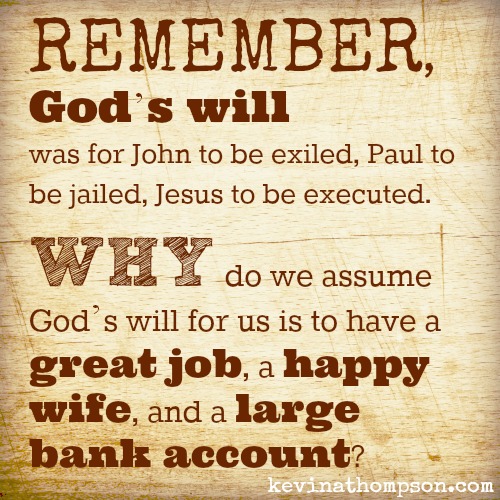
Remember, God’s will was for John to be exiled, Paul to be jailed, Jesus to be executed. Why do we assume God’s will for us is to have a great job, a happy wife, and a large bank account?
Obey. And if suffering or failure follows your obedience, don’t be too quick to assume you have chosen wrongly. You obey and leave the outcomes to God.
Some related topics:
For a discussion on why a circumstantially terrible outcome can still be good, click here
For a discussion on being in God's will click here
For a discussion on how all things work together for good, click here
For a discussion on the dangers and fallacy of the prosperity gospel click here
___________________________________
*I'm not saying this was the case in this example but praying alone does not mean it's a good prayer. What do I mean? Christ said do not pray like the Pharisee's pray. Why? He later says they prayed to be seen of men. We can translate that to mean we aren't seeking God in our prayers but something else and asking God to come alongside us and give is what we think is best i.e. God isn't our end, only a means to something want more than God. Our problem is we don't often know what's best. Only God does. This is why Christ said "not my will but yours be done" after asking the Father to spare him the suffering he was about to face. 

Saturday, June 15, 2019

in this world, you will have tribulation


Christ said, "...in this world, you will have tribulation..." Struggle and pain are inevitable in a broken world made up of broken people - which includes you and I. 

To say it another way, we should not be surprised by struggle or think God has abandoned us when struggles happen. If we do not understand this we will be inclined to have a pity party or even fall into despair when things go wrong, thinking something's ¹uniquely wrong with us and God has painted a target on our back or worse yet, that God is not good or doesn't exist at all

We will also be tempted to position our lives so that avoidance of pain is our primary focus i.e. we will seek comfort and make ²pleasure our greatest pursuit. 

This of course, would be a mistake since struggle is not without a ³good purpose.

Is life only tribulation, struggle, suffering? No. We can legitimately enjoy and be genuinely grateful for the good gifts God provides, and are called to be. But, obtaining and enjoying His gifts is not our focus; God’s glory is. And not simply because glorifying God is asked of us but it is also desired by us. 

The irony and surprise is when we experience God's glory we also find ⁴our greatest joy and pleasure. This is our experience now when we trust Him and will be our uninterrupted state once we enter into eternity.

Once we understand that struggle is inevitable, the question then becomes whether we engage tribulation passively or actively; willingly or unwillingly.

There is active and passive suffering. Though they both ⁵can result in our conformity to Christ they're not the same in how we engage them.

Passive suffering occurs when we experience loss through circumstances we do not choose i.e. outside our control e.g. someone unjustly mistreating us, sickness -- our own or loved ones -- loss of some gift, job or material possession, or even a loved one etc. If we live any length of time we all will encounter these challenges.

Active suffering is to willingly -- actively -- become a living sacrifice. It is choosing daily to deny ourselves, take up our cross and follow Christ.

If we do not willfully (actively) participate in suffering, we will still experience passive suffering simply because the world is broken but most importantly because God ⁶is always working to make us like his Son no matter how much we intentionally or unintentionally, willfully or unwillingly participate.
______________________________________________________________

¹And of course something is wrong with us. I'm referring to something being uniquely wrong, when in fact we all experience the same plight i.e. that verse is not just for us alone. The “you” referred to is a universal you.

²And in fact many within the church do exactly that. The result is what is sometimes called the "prosperity" gospel or the "health and wealth" gospel.

³For a fuller discussion of that good purpose click here.

⁴For a fuller discussion of Gods glory being our greatest joy click here.

⁵In both active and passive suffering, trust is central. We must trust God is working for our good -- i.e. to make us Christlike -- if we are to fully gain the benefit He intends from struggles. In active suffering we step our in faith knowing we honor God in our obedience. In passage suffering we look to Jesus, the founder and perfecter of our faith, who for the joy that was set before him endured the cross, despising the shame, and is seated at the right hand of the throne of God. - Heb 12:2

⁶"And I am sure of this, that he who began a good work in you will bring it to completion at the day of Jesus Christ." Philippians 1:6


Sunday, December 18, 2016

The fallacy of the "prosperity gospel"

You may have heard the expression the "prosperity gospel" or the "health and wealth gospel." But what exactly is it? Is it truly the heart of God's good news? We definitely prosper through the gospel, but in what way? 

The prosperity gospel subtly implies God is not our ultimate pursuit but only a means to another goal of a healthy and wealthy life; a life where our greatest joy is in circumstantial or physical and material comfort/ benefits, not in our relationship with God. 

Tim Keller touches on this in the following quote:

"We tend to see God as a means through which we get things to make us happy. For most of us, He has not become our happiness." - Timothy Keller (@timkellernyc):

This is only "seeking and praising God" for what he 
¹gives us, not for who he is, therefore it is not actually seeking God in the truest sense, but created things. God is important only because he is considered the best means by which to obtain something else, i.e. health and wealth. In essence, the prosperity gospel does not truly seek God or seek to honor God but only use him. No one wants to be used in this way.

For these reasons, the "prosperity gospel" is ultimately destructive. Why? It can draw us away from God, not to him. It draws us to a sense of value and meaning in created things, which are temporary, when true meaning and value are only in Him. It is appealing because it caters to our fallen condition i.e. to our desire to be our own god (our bent towards independent self-trust) instead of dependence on the only true God. 

The problem however is not in the prosperity gospel in itself, it is in our hearts. Our hearts, in our present broken condition (even as his children), are naturally inclined to seek life apart from or outside of God. 

If our hearts were truly and fully inclined to God and not to rebellious distrust and independence from God, there would be no prosperity gospel. It would have no appeal.

Only when we find God to be the one and only true satisfier of our heart and the sustainer of life, might he grant us uncommon health and wealth if (and only if) it advances his good purposes in us and the world for his glory. 

This is contingent on two things. 

1. Our gifts/calling 

    and 

2. our heart. 

Not all are gifted to do well in business, and only he knows our hearts well enough to know when they are after him and not wealth. We only think we know.

However, we must also keep in mind we are in a broken world, and in this world, we will face tribulation i.e. 
trouble (John 16:33). Not to mention, we will all eventually die. Our joy does not come primarily from God granting us circumstantial bliss and success, but that he redeems our brokenness and the brokenness of this world in bondage, for our ultimate good and His greatest glory i.e. he has overcome this broken world by allowing himself to be broken by it and raised back to life. Because he was raised to life, so will we be in him. The ultimate hope of the prosperity promised in the gospel is a life of bliss in God's presence for all eternity - not necessarily in this life.

Once we find God to be our life - not use Him for personal/private gain - our health and wealth is no longer our focus, for we have true life in him now and will experience it fully (i.e. circumstantially) once we are in his once-obscured, unfettered presence and totally restored (glorified) in eternity with him.  

12 For now we see in a mirror dimly, but then face to face. Now I know in part; then I shall know fully, even as I have been fully known. 1Cor 13:12(ESV)


"People knew God, but they did not honor him as God, and they did not thank him. 

Their ideas were all useless. There was not one good thought left in their foolish minds. They said they were wise, but they became fools. 

Instead of honoring the divine greatness of God, who lives forever, they traded it for the worship of idols—things made to look like humans, who get sick and die, or like birds, animals, and snakes. 

People wanted only to do evil. So God left them and let them go their sinful way. And so they became completely immoral and used their bodies in shameful ways with each other. 

They traded the truth of God for a lie. They bowed down and worshiped the things God made instead of worshiping the God who made those things. He is the one who should be praised forever. Amen." - Rom 1:21-25

For a discussion on excellence click here

For a discussion on diligence click here

For a discussion on the importance and necessity of sowing click here.

Is competition good or bad? click here
___________________________________

¹This way of "approaching God" leads to disastrous results. I think it is the reason many walk away from Christianity. In truth, they are not walking away from Christ but from an adulterated version of Christianity called the "property gospel." If you listen to Kanye West's reason for walking away from Christianity, he basically said it was because he asked God to do certain things that He didn't do. When God didn't do them, Kanye decided he could take care of it better than God i.e. basically he decided he is better at being God than God is. This is the very attitude Adam took in the garden and the exact opposite of Paul's response when Paul asked God to remove his thorn three times.

The desiring and pursuit of creation over the Creator is actually at the heart of mankind's problem and why we turned (and turn) away from God.
 
"For although they knew God, they did not honor him as God or give thanks to him, but they became futile in their thinking, and their foolish hearts were darkened. Claiming to be wise, they became fools, and exchanged the glory of the immortal God for images resembling mortal man and birds and animals and creeping things." - i.e. created things. -  Romans 1:21-23 ESV‬